Sidewalks and walkways look simple, but in Evansville the first question is often whether the concrete is yours to change. A path inside your property is a private project. A public sidewalk is governed by the City, with its own permits, contractor rules, and a cost-share program. This guide separates the two, explains how Evansville’s rules work, and covers planning a private walkway.
Serving homeowners planning sidewalks and walkways in Evansville and Vanderburgh County, Indiana.
Private Walkway or Public Sidewalk? Why It Matters
Look at where the concrete sits. A walkway entirely on your lot is a private project. The sidewalk along the street, usually between your property and the curb or street, is a public way. The two are treated differently under the Evansville Municipal Code (Chapter 12.05, Streets and Sidewalks):
| Private walkway on your lot | Public sidewalk in Evansville | |
|---|---|---|
| Who sets the rules | You, plus zoning and any HOA | The City, through the Board of Public Works and City Engineer |
| Permit | Depends on the project. Confirm with the Building Commission | The code requires a Board of Public Works permit to construct, alter, or repair any sidewalk (EMC 12.05.230) |
| Contractor | Any qualified contractor | The code requires a license and bond for concrete work in sidewalks, streets, and public grounds (EMC 12.05.260). Ask for proof |
| Who pays | You | Where no sidewalk exists, the abutting owner pays to build one. Where one exists, a cost-share program may apply (see below) |
| Standards | Your design | Construction under the chapter must follow the Americans with Disabilities Act (EMC 12.05.010) |
The code text is as published online and may be updated, so confirm current requirements with the Board of Public Works before work begins.
Who Pays for Public Sidewalk Repair in Evansville?
The City’s code sets up a cost-share program for abutting owners who petition for sidewalk repair or replacement. For petitions submitted on or after January 1, 2006, the cost is split 50 percent City and 50 percent abutting owner, and the owner’s share can be paid over up to 10 years under the state’s Barrett Law process, recorded as a lien against the property (EMC 12.05.030 to 12.05.050). As an illustration, the code itself uses a $700 repair, where the owner’s half would be $350.
A few things to know:
- The program is subject to annual funding by the City Council, and the City may decline a petition.
- You petition the Board of Public Works. A single owner can petition for a spot repair, while a full-block replacement needs a petition signed by owners of over 50 percent of the lots on the block.
- Where the City meets its criteria, priority is also affected by location (for example, near schools or on busier streets).
- ADA-approved curb ramps are the City’s responsibility.
- If you want a driveway redone or a walkway extended between the sidewalk and the curb, the owner pays for that work in full, though the cost can be added to the sidewalk billing.
Ask the Board of Public Works whether petitions are currently being accepted, and what forms and funding are available now.
For the full walk-through, see our guide: Who Pays for Sidewalk Repair in Evansville?
How the City Decides Which Sidewalks Qualify
For spot repairs, the code uses measurable conditions. If a sidewalk meets none of them, the program will not fund the repair. They are also a useful yardstick for judging your own sidewalk with a ruler and tape measure. These are the City’s funding criteria, not a legal standard for private walkways.
Use the graphic below to measure your own sidewalk. The table that follows gives the same numbers in text.
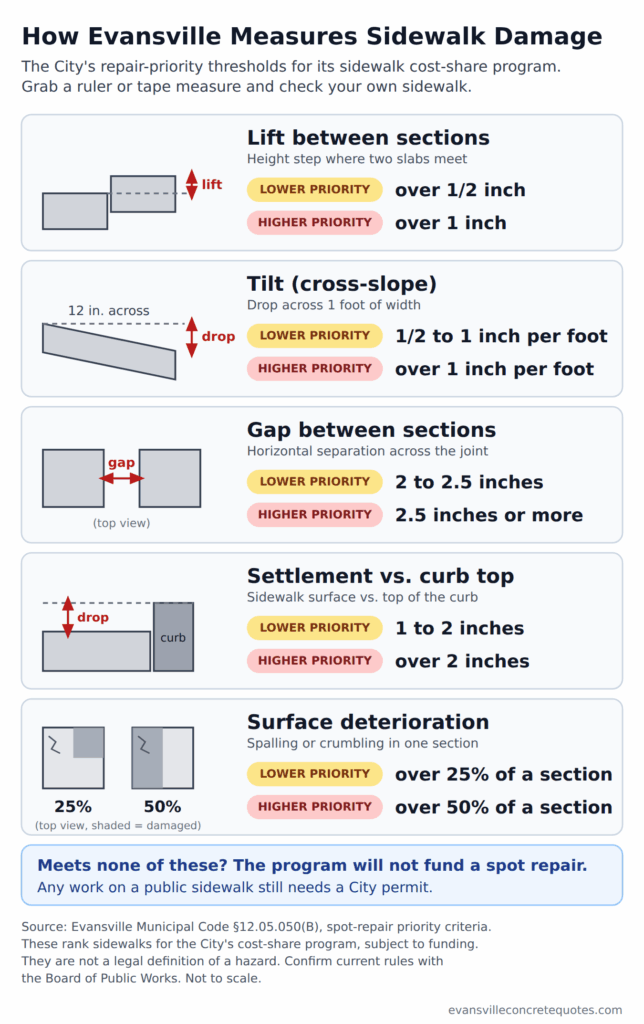
| Condition | Lower priority (Level 2) | Higher priority (Level 1) |
|---|---|---|
| Lift or separation between sections | Over 1/2 inch | Over 1 inch |
| Tilt or cross-slope | 1/2 to 1 inch per foot | More than 1 inch per foot |
| Horizontal separation | 2 to 2.5 inches | 2.5 inches or more |
| Lift or settlement from the top of the curb | 1 to 2 inches | More than 2 inches |
| Spalling or deterioration of a section | Over 25 percent | Over 50 percent |
Photograph the problem with a tape measure in the frame before you petition. If your sidewalk is damaged but below these thresholds, you may need to pay for the repair yourself or ask a contractor about repair options. See our repair guide.
Planning a New Private Walkway
- Route. Follow where people actually walk. A path that fights natural shortcuts tends to get walked around.
- Width. Think about who and what will use it: two people side by side, a wheelbarrow, a stroller, or a wheelchair.
- Slope. Keep it gentle. Evansville’s own repair criteria treat a cross-slope above 1 inch per foot as a high-priority defect, so a new walkway should stay well under that.
- Connections. Plan how it meets steps, doors, the driveway, and any patio so you avoid awkward lips and low spots.
- Finish. A broom finish gives traction. For decorative options see our stamped concrete guide.
Drainage, Snow, and Evansville Weather
Evansville’s code says you may not allow water other than normal rainfall runoff to flow from your property onto a public way (EMC 12.05.120), so plan where downspouts and walkway runoff go. It also makes the occupant of a property responsible for removing snow and ice from the sidewalk next to it, and allows sand, salt, or sawdust where ice is frozen too hard to remove (EMC 12.05.170).
That duty matters for concrete. Evansville Regional Airport averages about 83 days a year below 32°F (GLISA / NOAA data, 1991-2020), so walkways get de-icing chemicals and freeze-thaw cycles. Ask your contractor whether to avoid de-icers on new concrete during its first winter, and how the mix and finish handle traction. Our driveways guide covers air-entrained mixes and curing.
Why Sidewalks Settle, Crack, or Lift
Common causes include water washing out the base, tree roots, poor compaction after earlier digging, and missing or ineffective joints. A repair that ignores the cause tends to fail again. With roots, get advice before cutting any large ones, since the tree’s health can be affected. Replacement typically means removing the affected sections, correcting the base and grades, and pouring new concrete with planned joints.
Thickness, Joints, and Where Walkways Meet Driveways
A walkway carries foot traffic, so it generally needs less than a driveway, and industry guidance commonly lists 4 inches as the minimum for residential flatwork. Where a walkway crosses a driveway or serves as part of the entrance, it may carry vehicles, so ask what thickness is planned at that point. Narrow walkways usually need joints at closer intervals than wide slabs. See our thickness guide for how thickness changes concrete volume.
What Affects Sidewalk and Walkway Cost?
- Length and width
- Removal and disposal of old concrete
- Base work, grading, and drainage
- Access for equipment and workers
- Tree roots and landscaping
- Curves, steps, and connections to existing concrete
- Finish and decorative options
- Permits and City requirements for public sidewalk work
See our concrete cost guide for published price ranges and how to compare quotes.
Questions to Ask About a Sidewalk Estimate
- Is this a private walkway or a public sidewalk, and does anything fall in the public right-of-way?
- Does this work need a City permit, and who will get it?
- Does the contractor hold the City sidewalk contractor license and bond if the work is on a public sidewalk?
- Are tree roots or drainage problems likely to affect the work?
- How will the new sidewalk meet the driveway, steps, and existing sections?
- What thickness is planned where it crosses a driveway?
- When can I walk on it, and what de-icing products are safe?
Concrete Sidewalk FAQs
Who is responsible for the sidewalk in front of my house in Evansville?
The code makes the abutting owner responsible for building a sidewalk where none exists, and for snow and ice removal on the sidewalk next to the property. For repairs of existing public sidewalks, it describes a cost-share program that begins with a petition. Confirm the current process with the Board of Public Works.
Can the City help pay to replace a sidewalk?
The code describes a 50/50 cost-share program, funded annually, for sidewalks that meet its repair criteria. It is not automatic, and the City may decline a petition.
Do I need a permit to replace a sidewalk?
For public sidewalks, the code requires a permit from the Board of Public Works to construct, alter, or repair. A walkway entirely on your lot may be treated differently, so confirm with the Building Commission.
Can any contractor replace a public sidewalk?
The code requires a license and bond for contractors laying concrete in sidewalks and other public ways. Ask for proof before hiring.
What counts as a trip hazard?
There is no single rule for every walkway, but the City’s own criteria prioritize lifts over 1/2 inch, and especially over 1 inch, between sections. Use them as a yardstick.
How soon can I walk on a new sidewalk?
Follow your contractor’s instructions. Industry guides commonly suggest about 48 hours for foot traffic, but weather and mix design can change that.
Sources: Evansville Municipal Code, Chapter 12.05, Streets and Sidewalks (codepublishing.com); GLISA, Evansville Regional Airport climate summary. Code text may change. This is general information, not legal advice, and it does not replace a contractor’s evaluation of your property.
Request a Concrete Sidewalk Quote in Evansville
Planning a new walkway or repairing an uneven sidewalk? Tell us whether it is on your lot or along the street, how much concrete is involved, and your timing to request a quote from a local concrete service provider.
Serving homeowners planning sidewalks and walkways in Evansville and Vanderburgh County, Indiana.