Last reviewed October 2026. Based on the Evansville Municipal Code, Chapter 12.05, as published online. Confirm current details with the Board of Public Works.
Short answer: it depends on the kind of sidewalk work. To repair or replace an existing public sidewalk, Evansville’s code sets up a cost-share program: the City pays 50 percent and the abutting property owner pays 50 percent. That only happens if the owner petitions, the sidewalk meets the City’s damage criteria, and the City has funding for it. Where no sidewalk exists, the abutting owner pays to build one.
Who Pays for What: A Quick Reference
| Situation | Who pays | Code section |
|---|---|---|
| Building a sidewalk where none exists | The abutting property owner | 12.05.010 |
| Repairing or replacing an existing public sidewalk through the City program | Shared 50/50 between the City and the abutting owner (petitions on or after Jan. 1, 2006), subject to funding | 12.05.030, 12.05.050 |
| ADA-approved curb ramps | The City | 12.05.020 |
| Repairs the City chooses to make itself, such as part of a major construction project | The City, at its discretion | 12.05.010 |
| Redoing a driveway at an approved curb cut, or extending a walkway between the sidewalk and the curb | The owner, in full (it can be added to the sidewalk billing) | 12.05.050 |
| Keeping a sidewalk ADA-compliant around a pole, meter, or sign post in it | The utility | 12.05.050 |
| Removing snow and ice from the sidewalk | The occupant (or the owner if the building is unoccupied) | 12.05.170 |
Source: Evansville Municipal Code, Chapter 12.05, Streets and Sidewalks. The program is subject to annual funding by the City Council, so it is not automatic.
How the Cost-Share Program Works
- Check the damage. The City only funds sidewalks that meet its criteria (see the next section).
- Petition in writing. For a spot repair, each abutting owner who wants it petitions the Board of Public Works, and every owner of the lot signs. For a full-block replacement, owners of over 50 percent of the lots along the block must sign.
- The Board classifies and ranks petitions. Within each damage level, streets within two blocks of a school, church, publicly owned building, or government office come first, then streets with over 10,000 vehicles a day, then those with 5,000 to 10,000.
- The City may decline or redirect. It can review the block and decline a spot repair, or ask for a petition covering the full block. If 50 percent or fewer of the abutting owners want a full-block replacement, the City may decline the spot repair.
- Funding decides. The code states the program is subject to funding by the City Council.
- You pay your share. The City finances the owner’s half under Indiana’s Barrett Law, repaid over up to 10 years.
The Board of Public Works adopts the petition forms. Ask the office whether petitions are currently being accepted and what funding is available.
Does Your Sidewalk Qualify?
For a spot repair (less than a full block), the code ranks a sidewalk as Level 1 (higher priority) or Level 2 (lower priority) based on measurable conditions: lift or separation between sections, tilt (cross-slope), horizontal gaps, settlement from the top of the curb, and surface deterioration. If a sidewalk meets none of them, the code says the spot repair will not be funded.
Use the graphic below to measure your own sidewalk. The table in our sidewalks guide gives the same numbers in text.
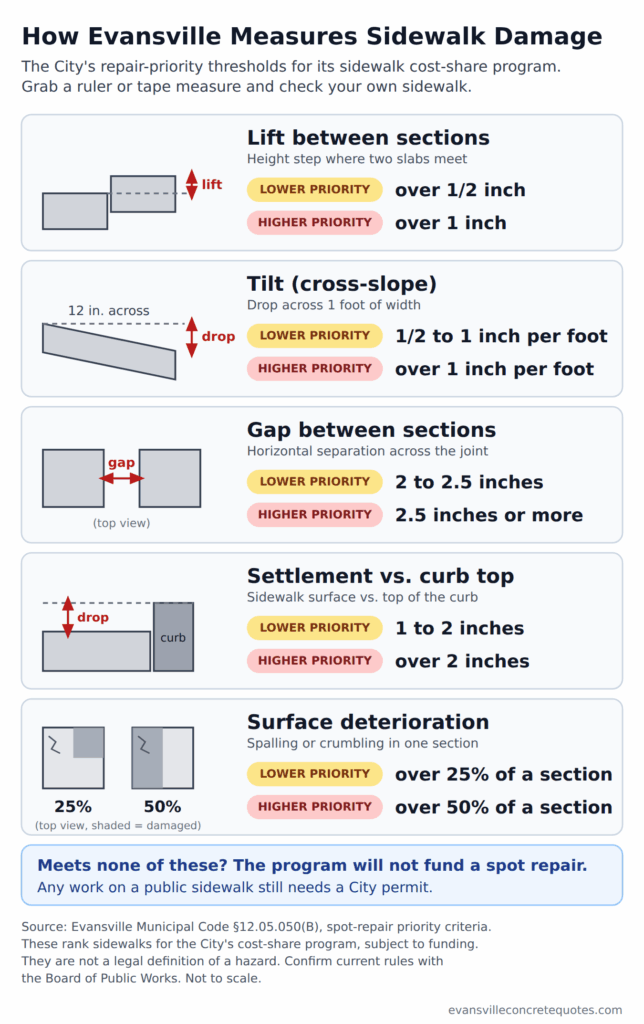
A full-block replacement means one side of a street from intersection to intersection. It has its own tests, which look at the share of sections on the block that have damage: for example, at least 75 percent of sections with Level 1 conditions ranks highest.
What Your Share Might Cost
The code illustrates with a $700 repair. On a 50/50 split the owner owes $350, which could be paid as a lump sum, in equal installments of $35 a year over 10 years, or in payments for several years followed by paying off the balance. The amount owed is recorded as a lien, so it stays with the property if it is sold. Assessments are based on your frontage in feet.
That $700 figure is the code’s own example, not a price quote. Your actual cost depends on your frontage and the work required.
Special Cases
- Corner lots. If the full-block replacement is needed on more than one side, the owner pays the cost-share on the first side and the City pays for the other in full. Spot repairs on the lot are still cost-shared.
- Owners with a property tax exemption. If you hold a valid over-65 or blind or disabled exemption with the Vanderburgh County Auditor, you may pay in full, pay over 10 years on the property assessment billing, or have the City place a lien for the full amount, due when the property transfers or the exemption ends.
- Driveway curb cuts. If you have an approved curb cut and want to redo the driveway there, or extend a walkway between the sidewalk and the curb, you pay in full and need all necessary approvals. The City does not share that cost.
- Obstructions. A pole, meter, or sign post in the sidewalk is the utility’s responsibility to make ADA-compliant, with the Board of Public Works approving the design.
Can You Hire Your Own Contractor Instead?
Yes, but there are rules for public sidewalks. The code requires a permit from the Board of Public Works to construct, alter, or repair any sidewalk. It also requires a license and a bond for anyone in the business of laying concrete in the City’s sidewalks, streets, and public grounds, and says sidewalk construction must follow ADA requirements. Ask any contractor for proof of the license and bond, and who will pull the permit. Our sidewalks guide covers this in more detail, and our cost guide explains how to compare quotes.
Your Other Responsibilities
- Snow and ice. The occupant of a property next to a sidewalk must remove snow and ice. If it is frozen too hard to remove, the code says to sprinkle sand, salt, or sawdust to make it safe to walk on.
- Runoff. Water other than normal rainfall runoff may not flow from your property onto a public way, so check where your downspouts and sump discharge go.
If Your Sidewalk Is Damaged: What to Do
- Measure the problem with a tape measure and take photos with the tape in the frame.
- Compare your measurements with the City’s thresholds in the graphic above.
- Contact the Board of Public Works for the current petition form and to ask whether funding is available.
- If the damage affects most of a block, talk to your neighbors about a full-block petition.
- If it does not qualify, or you cannot wait, get quotes from licensed sidewalk contractors, and confirm the permit.
- Keep your records: photos, measurements, petitions, and any replies from the City.
What This Page Cannot Tell You
The code excerpt on this page does not address who is liable if someone is injured on a sidewalk. If that is your concern, ask an attorney or your insurer. The cost-share provisions date from the mid-2000s and may have been amended, and programs depend on annual funding. This is general information, not legal advice.
Sidewalk Repair in Evansville FAQs
Is the City of Evansville responsible for repairing my sidewalk?
Not automatically. The code describes a cost-share program that begins with your petition, subject to funding, and says the City may also make repairs on its own at its discretion, for example as part of a major construction project.
Can I pay my share over time?
Yes. The City uses the Barrett Law process, which lets you pay in a lump sum, in equal annual installments over up to 10 years, or by paying down the balance later.
Who pays for curb ramps?
The code makes ADA-approved curb ramps the City’s responsibility.
Do I need a permit to fix my own public sidewalk?
The code requires a permit from the Board of Public Works to construct, alter, or repair any sidewalk. Confirm the current process with that office.
What if my sidewalk does not meet the criteria?
Then the program will not fund a spot repair, though you can still repair it at your own expense with the permit and licensed contractor the code requires.
Who clears snow from the sidewalk?
The occupant of the property next to it, or the owner if the building is unoccupied.
Sources: Evansville Municipal Code, Chapter 12.05, Streets and Sidewalks (sections 12.05.010 to 12.05.050, 12.05.120, 12.05.170, 12.05.230, 12.05.260). General information, not legal advice. Confirm current rules with the Board of Public Works.
Need a Sidewalk Quote in Evansville?
Whether your sidewalk is on your lot or along the street, tell us about the project to request a quote from a local concrete service provider. For public sidewalk work, ask about the City permit and contractor license.
Helping homeowners in Evansville and Vanderburgh County, Indiana.